

Why Read Sanskrit in the Original?
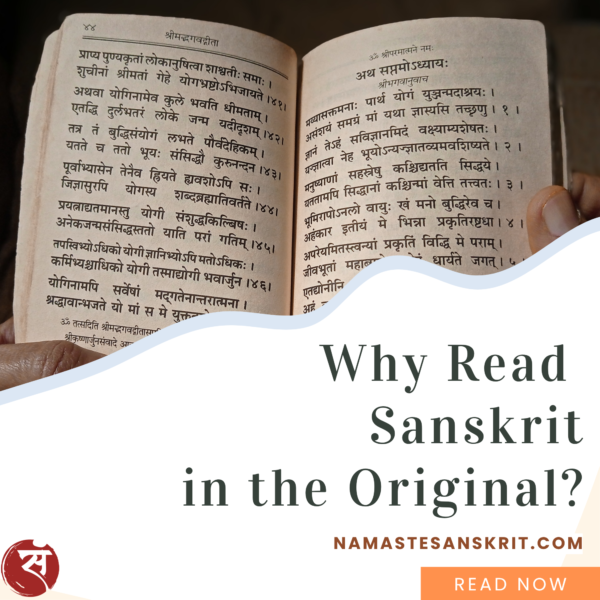
There is a strange habit we have developed.
We have inherited an enormous body of Sanskrit literature, but when we want to understand it, we often immediately look for a translation.
I understand why.
Sanskrit can seem difficult.
A translation feels easier.
Someone has already done the work.
We simply read the meaning in English, Hindi or Gujarati and move on.
Namo Namaste. Dr. Namrata Patel here. But after spending years studying Sanskrit, I have started to feel that something important happens when we depend only on translation.
We may understand the message.
But we may miss the experience of the original.
A translation is valuable, but it is still a translation
I want to make one thing clear.
I am not against translations.
Translations are extremely important.
They open doors.
They allow people who do not know Sanskrit to access ideas that might otherwise remain beyond their reach.
But a translation is someone’s interpretation of the original.
It is an attempt to carry meaning from one language into another.
And some things travel beautifully between languages.
Some do not.
A Sanskrit word may contain a range of meanings, associations and ideas that cannot always be captured by one English or Gujarati word.
Sometimes, even after a long discussion, we arrive at:
“This is close, but it is not exactly the same.”
That “not exactly” matters.
I discovered this while teaching
I remember discussions with students where we could spend twenty minutes exploring one Sanskrit word.
Why?
Because the English translation seemed simple.
But when we returned to the Sanskrit, we found more.
A particular word may carry context.
Grammar may influence meaning.
The choice of one word instead of another may tell us something.
The structure of a sentence may add emphasis.
These are not always visible in translation.
And that is why reading the original can become a completely different experience.
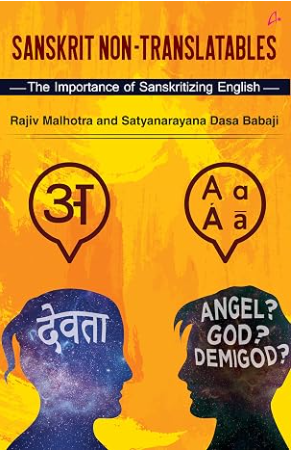
Many a times Sanskrit words cannot be translated! Check out this book Sanskrit Non-Translatables by Rajiv Malhotra ji.
Imagine reading someone else’s letter
Suppose someone writes you a deeply personal letter.
A friend reads it and tells you:
“She said that she is grateful to you and misses you.”
You understand the basic message.
But then imagine reading the letter yourself.
You see the exact words.
The pauses.
The expressions.
The way the person chose to say something.
You may notice something your friend did not mention.
A scripture is obviously far more complex than a personal letter, but the principle is similar.
When we read a text in its original language, we have a direct relationship with the words.
We are no longer completely dependent on someone else’s reading.
Why this matters for our scriptures
For many people, the Bhagavad Gita is something they have encountered through translations.
We may know its famous teachings.
We may have heard explanations from speakers.
We may have watched videos.
We may have read social media posts.
But how many of us have opened the Sanskrit text itself?
How many of us can actually read the verse?
How many can pause at a word and ask:
“Why has this word been used?”
That is where language becomes powerful.
The text begins to speak to us directly.
The problem of the internet
This has become even more important today.
We live in a world where information travels incredibly quickly.
Someone reads a sentence somewhere.
Posts it online.
Another person copies it.
A third person creates a video.
A fourth person turns it into a quote.
Soon, thousands of people believe it because they have seen it repeatedly.
But repetition does not make something authentic.
I sometimes see Sanskrit verses, mantras and meanings circulating online with incorrect pronunciation or questionable explanations.
The problem is not only that one person has made a mistake.
The problem is that thousands of people may then repeat the same mistake.
This is why learning to go back to the original matters.
The example of Shikshapatri
A particularly meaningful example for me is the Shikshapatri.
It contains 212 shlokas written in Sanskrit and holds an important place in the Swaminarayan tradition.
Many devotees may read translations or listen to explanations.
But there is something special about being able to open the Sanskrit text and read the shloka yourself.
You don’t need to become a Sanskrit scholar overnight.
Start with one verse.
Read it in Devanagari / Read it in Roman.
Listen to its pronunciation.
Understand each word.
Then read the translation.
Now compare.
What did the translator explain?
What did you notice?
What did you understand?
That is learning.
The joy of discovering a word
Original texts ask us to participate. A translation can sometimes make us passive.
We read and accept.
But the original asks us to participate.
We have to look. Think.Question.Investigate.Learn.
This is one reason I enjoy Sanskrit so much.
It does not always give me the answer immediately.
It makes me work for it.
And that process itself becomes meaningful.
One of the most beautiful experiences in Sanskrit is discovering that a single word can open a door.
You begin with one meaning.
Then you look at its root. Its grammatical form. Its context.
Its use in another text.
And suddenly, the word feels alive.
You are not merely translating it.
You are discovering it.
This is why I often say that Sanskrit is not just about memorising words.
It is about learning to look closely.
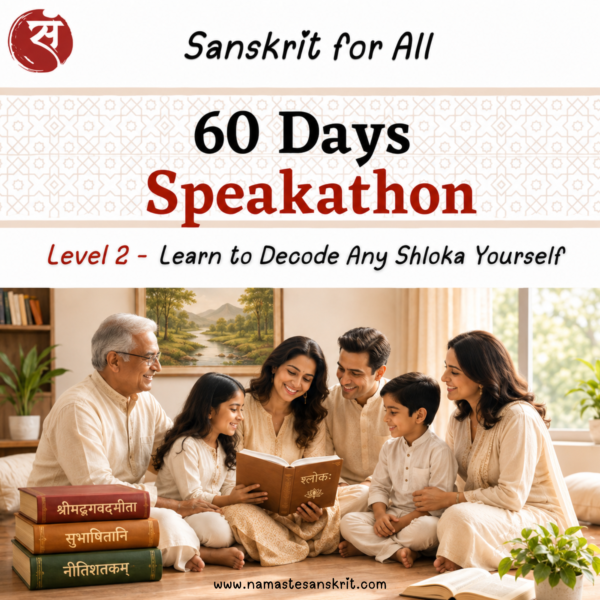
What if we started small in 60 DAYS?
You don’t have to start with a complicated philosophical text.
Begin with a shloka you already know.
Read the Devanagari.
Learn the pronunciation.
Understand the grammar gradually.
Read the words individually.
Then read the translation.
Slowly, your dependence on translation begins to reduce.
And something wonderful happens.
The original text starts becoming familiar.
JOIN 60 days Speakathon that focuses that you develop this ability!
A culture should not become something we know only through other people’s explanations.
We should certainly learn from scholars.
We should read translations.
We should listen to teachers.
But wherever possible, we should also develop the ability to approach our own texts directly.
Not because translations are bad.
Because direct access is empowering.
It allows us to ask our own questions.
It allows us to discover.
It allows us to verify.
And it creates a deeper relationship with the knowledge we have inherited.
The greatest gift of learning Sanskrit is not simply that we can say, “I know Sanskrit.”
It is that one day we can open an ancient text, look at the words ourselves and say:
“Let me see what it says.”
And then begin the journey of finding out.
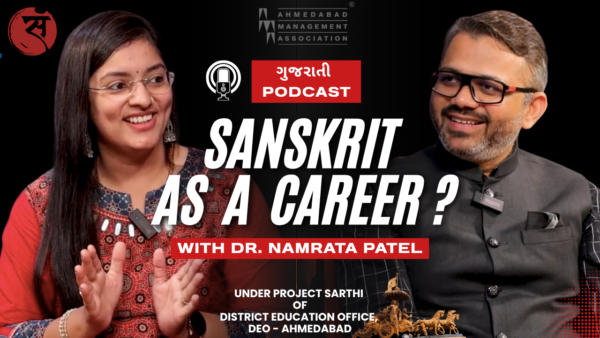
Watch the complete conversation
There is much more to this story – the struggles, the unusual choices, the people who supported me, and how my journey from being a student of Sanskrit eventually led to the creation of Namaste Sanskrit Institute.
If you would like to hear the complete conversation and explore the story in my own words, watch the complete video on our YouTube channel.
Tags:
Sanskrit, Sanskrit Scriptures, Original Texts, Bhagavad Gita, Shikshapatri, Sanskrit Translation, Indian Knowledge Systems, Sanskrit Learning, Vedic Literature, Sanskrit Heritage